

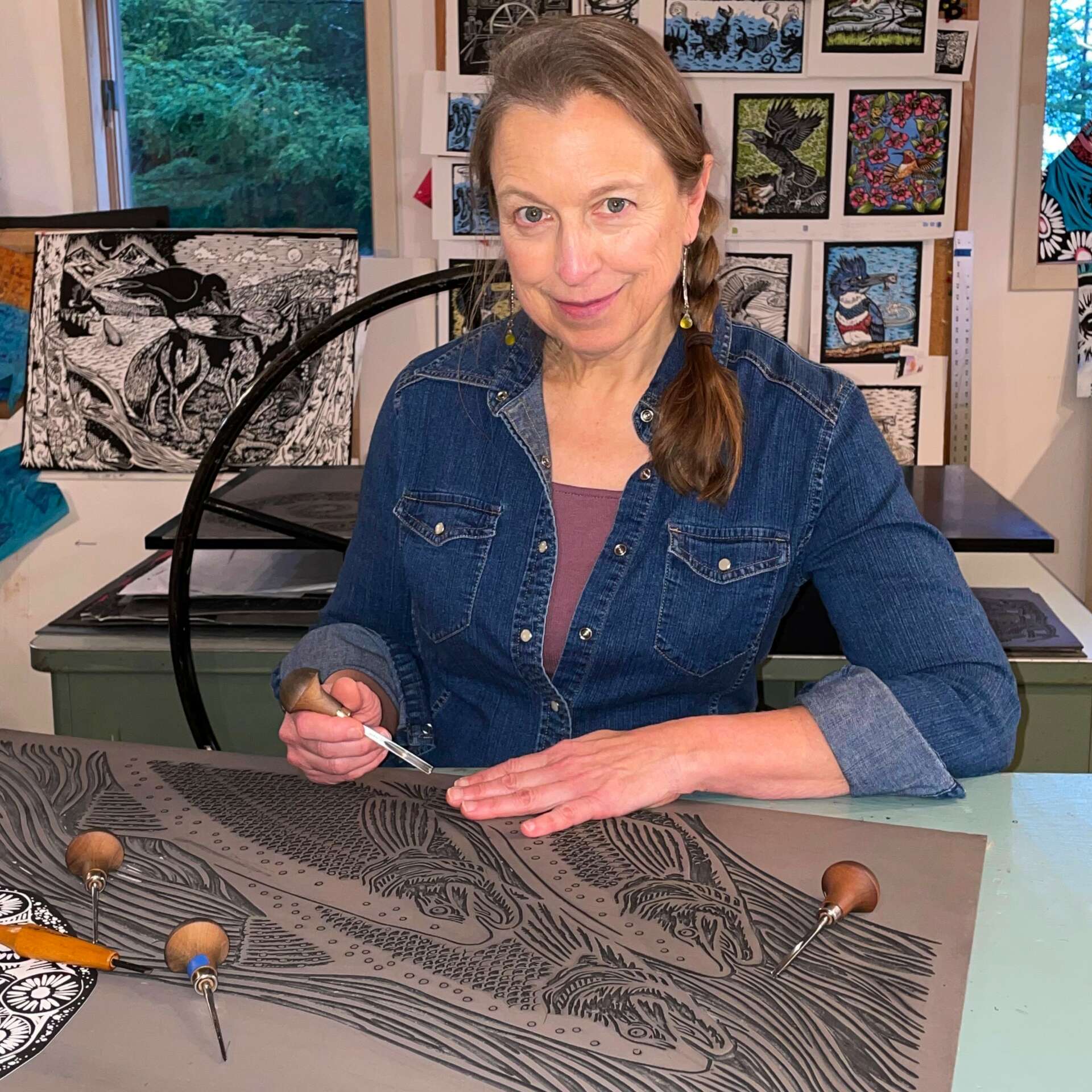

We recently connected with Evon Zerbetz and have shared our conversation below.
Evon, looking forward to hearing all of your stories today. Earning a full time living from one’s creative career can be incredibly difficult. Have you been able to do so and if so, can you share some of the key parts of your journey and any important advice or lessons that might help creatives who haven’t been able to yet?
My journey into my career as a full-time artist took an organic path. I knew early on that making things with my hands was what I was driven to do, Then, following my freshman year at university I made a pivot that I might want to do something different in the world and switched to studying sciences. That led to working in Alaskan fisheries for about 10 years. Somewhere in that decade I stood at another fork in the road, One fork had an arrow pointing to going back to school to pursue arts, and the second fork had an arrow pointing to travel. I picked the latter,
I traveled by myself on a shoestring on my off-work seasons, and along the way I was able to pick up art courses—at the Bellas Artes in Mexico, and the Bezelel in Jerusalem, When in life drawing classes surrounded by your non-native language, it’s easier to tune out and sink in to the practice. This time were very formative, as was the printmaking and painting classes I picked up back home when Ray Troll had created an art department at University of Alaska Southeast – Ketchikan campus.
Having dabbled in a myriad of mediums with mediocre results, there was something about relief printmaking that clicked in for me. I loved the physicality of carving, or thinking in reverse, mark making with a knife, and inking and hand cranking my blocks through a press. I have a facility to look at things and read upside down, which I am not certain if it came from my work, or made the work more natural to me. I quickly abandoned woodcut for linocut, which gave me more free-range of motion in my carving marks. (Although I am presently intrigued with going back to some wood.)
I began editioning my linocuts and mixing them with some mixed media – primarily monotypes, and was soon selling my linocut editions in galleries in Alaska, Washington, and Minnesota. I was working seasonally in fisheries, and building my art career at the same time, and realized in 1996 that…something had to give, I was completing my first picture book for children, and was overly busy with my dual career.
I decided that if I was going to go into art full-time, this was the time, I decided to give it a go for a year, and have been a full-time self-supporting artist ever since.
Since my beginnings of working primarily with galleries, I have expanded my work to illustrating children’s books with my linocuts. (yes, I carve a full size block for every page in every book!) and developing a graphics line of art cards, Later I got opportunities to translate my linocuts into large-scale works for public art installations. I have been able to work in many mediums, glass, steel, and wood, with my linocuts as a base for my designs. Additionally, I was doing commissions, artist-in-school residencies around the state of Alaska in both village and urban settings.
I call this the multi-prong approach to making a full-time living, one area of income might be vibrant, while another is quieter.. For example I was making a living mainly from my public art for a decade, After the pandemic, public art work projects slowed, but commissions and my graphics line came back strong.
Thinking about my path, I don’t know if I could have built the career that I have now if I had chosen art school. Art school can bring a many benefits and status, but I simply wanted to keep making things with my hands. Building up my art career while doing something else made it a very natural transition when I was ready.


Great, appreciate you sharing that with us. Before we ask you to share more of your insights, can you take a moment to introduce yourself and how you got to where you are today to our readers.
I work primarily in the field of relief printmaking—specifically linocut, When people ask what I do, I note that they may have dabbled with this in 5th grade…and I this is how I make my living. My linocuts have created the basis for much of my work in a myriad of formats,
Beyond galleries, my linocuts have illustrated an armful of books for children and adults. I love to design for this format the surprise or reveal as the reader turns the page.
I design linocuts to help people and instituitions communicate with the public. You might see my linocuts illustrating posters I’ve illustrated for the Alaska State Health WIC program push-pinned to the school nurse’s office, for Sitka Whalefest wine labels, music festivals, or book fests.
I was commissioned by the U.S. Fish and Wildlife Service to design a large linocut that would become the wrap for a rolling science museum on wheels for the Silvio O’Conte Wilderness refuge which stretches over 8 states in the NE along the Connecticut River.
My linocuts have also been translated into a 65-foot wall of architectural art glass in the Alaska State Library. and Archives which opened with the new State Museum in 2016. This three-year project may have been the pinnacle of my career so far. It took me to Germany to work in a glass studio with a team including Natalja Böttger and Roland Prahl, and to Canada to oversee the fabrication of the wood components of the piece. “We are Written in the Layers of the Earth” is a combination of grisaille, vitreous paint, handblown antique glass, etching and silver stain and etched red alder. Having never worked in glass before, the public art selection team, including Andrea Noble from the Alaska State Arts Council, Bob Banghart as the head of the museums department, and lead engineer Kim Mahoney, were visionaries in believing in a linocut artist to pull off the project.
Along the way I turned one of my books about ravens, Ten Rowdy Ravens, into a traveling multi-media exhibit that explored the natural history of the common raven. Complete with a giant board game in the area that explored the successful birds ability to have time to do what scientists can only explain as play, and a Raven Match Game to explore courtship in the birds, the exhibit mixed science with whimsy in modules that also looked at Ravens eating habits, nesting, and Ravens in Lore throughout the world. The exhibit, complete with a handpainted KAW COUCH, and handcrafted life size nest, traveled in ten crates from Ketchikan Museum to the New Mexico Museum of Natural History, the North Museum of Natural History, and the Alaska State Museum. Learning how to pull-off things I’ve never done before has always been attractive to me.


What can society do to ensure an environment that’s helpful to artists and creatives?
Art appreciation is a valuable skill. As artists, we often have concern about there being less galleries in a town to exhibit in, but I think we need to expand that concern to growing more art appreciators. Becoming a culture of people who broadly value and enjoy art in our daily lives, whether it is something we see in nature, the cup we are holding, or the sneakers we wear. An artful life.
Simply taking time to talk to kids about their art is an important starting point. I avoid telling a kid that their drawing or painting is “good”. I will tell them something that really lets them know that I AM really looking at their work…I use language like “I like the energy of your line work right here”, “I like how your composition fills up the page”, Or, “I like this spot where you put green and pink right next to each other.” Or maybe even how I feel when I look at their work. It is always something authentic and gives them ideas about how to talk about what they are seeing themselves. It works—suddenly they are talking to me about their work with these type of observations!


Have you ever had to pivot?
I’m in a giant pivot right now. Moving from artist to gallerist.
When the owner of the gallery I’ve been showing in locally for 31 years decided to close at the end of the 2023 to move on to new ventures. I stepped up to take it on starting in spring 2024. We feel like it’s a good fit. I will be able to simplify my own art career to take on fewer projects, focusing in on heart projects, which I believe will be rewarding at this point in my career.
Contact Info:
- Website: https://www.evonzerbetz.com/
- Instagram: evonzerbetz
- Facebook: https://www.facebook.com/evon.zerbetz
Image Credits
Chris Ahrend, Leonardo Rioja